


Yinchen Ni, a master’s student at Shanghai Jiao Tong University Global College (SJTUGC, abbreviated as GC hereafter), has won first place in the graduate category of the 2026 Association for Computing Machinery (ACM) Special Interest Group on Embedded Systems (SIGBED) Student Research Competition (SRC), held in Barcelona, Spain. Guided by GC Associate Professor An Zou, Ni was recognized for his innovative research on real-time computing in heterogeneous edge AI systems.

Yinchen Ni (center) receives the first prize certificate at the competition
Organized by ACM SIGBED, the competition took place during Embedded Systems Week (ESWEEK 2026). It attracted 30 undergraduate and graduate students from around the world. Following two rounds of research presentations and expert evaluation, one undergraduate student was selected as the winner, while two graduate students shared first place.
The SRC is an international academic competition for emerging researchers in real-time systems, embedded systems and cyber-physical systems. It evaluates the innovation and academic value of research, as well as participants’ presentation and defense skills.
With the rapid development of applications such as autonomous driving, robotics and embodied intelligence, modern computing systems increasingly rely on CPUs, GPUs and specialized accelerators working together to execute complex AI tasks. Improving computing performance while ensuring reliable real-time guarantees for time-critical applications remains a key challenge in embedded and real-time systems research.
Ni’s competition entry, “From Pre-Assembly to Runtime: Managing Timing Uncertainty in Heterogeneous Edge AI Systems,” brings together his master’s research on real-time performance in heterogeneous edge AI systems. Taking the entire computing lifecycle into account, the work explores methods for timing analysis and optimization across system design, deployment and runtime.
At the design stage, heterogeneous real-time task modeling, response-time analysis and design-space exploration are used to identify hardware and software configurations that satisfy real-time constraints. During deployment and runtime, resource allocation and scheduling are optimized according to the execution characteristics of heterogeneous resources, including CPUs and GPUs, and the current status of tasks. These approaches aim to meet task deadlines while improving resource utilization.
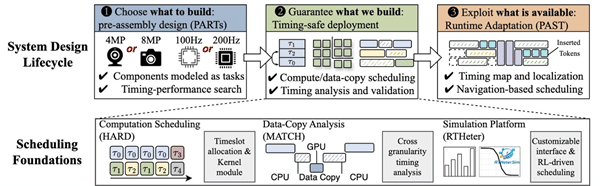
Research diagram of Ni’s award-winning project
The related research has been published or accepted for publication in IEEE Transactions on Computers and leading international conferences in real-time systems, embedded systems and computer architecture, including RTAS, RTSS, DATE and ICCAD.
Ni’s achievement builds on GC’s continued efforts to advance research in heterogeneous real-time computing and nurture young researchers. In 2022, Yuankai Xu, an undergraduate student supervised by An Zou, won first place in the undergraduate category of the ACM SIGBED Student Research Competition.
Personal Introduction

Yinchen Ni is a 2024-entry master’s student at GC. His research focuses on real-time computing systems on heterogeneous platforms, task scheduling and system optimization. He has received the National Scholarship and third prize in an embedded systems software research competition.

An Zou is an associate professor and doctoral supervisor at GC, as well as a Senior Member of IEEE. He received his PhD in electrical engineering from Washington University in St. Louis and previously conducted research on low-power design for Oculus VR processor chips at Facebook Reality Labs. His research focuses on hardware and software systems for edge AI, including lightweight inference, neural network accelerator architectures, large language model-assisted code generation and optimization, and real-time computing on heterogeneous GPU, TPU and FPGA platforms. His work has appeared in leading international conferences, including MICRO, RTSS, DAC, ACL, NeurIPS and AAAI, and in journals such as IEEE Transactions on Computers, IEEE Transactions on Computer-Aided Design of Integrated Circuits and Systems and IEEE Transactions on Parallel and Distributed Systems. He received the ACM SIGBED China Rising Star Award.


