


The 2025 Winter Design Expo of Shanghai Jiao Tong University Global College (SJTUGC, abbreviated as GC) officially opened on December 17, showcasing 46 student projects developed across multiple disciplines and academic levels. Ranging from solutions for everyday needs to innovations addressing complex industrial challenges, the exhibition attracted representatives from industry, faculty and students, and experts from related fields, who engaged in active discussion and exchange.
The projects on display were drawn from a wide range of experimental and design-oriented courses offered from freshman to senior year, including Introduction to Engineering, Undergraduate Research, System Design and Implementation, Design and Manufacturing, Product Design and Manufacturing, Computer Architecture, Computer Vision, and Laboratory II. Together, the exhibits presented a comprehensive overview of GC’s teaching outcomes, highlighting students’ creativity, teamwork, and hands-on engineering capabilities.
Freshman Projects: Engineering Practice from Real-World Observation
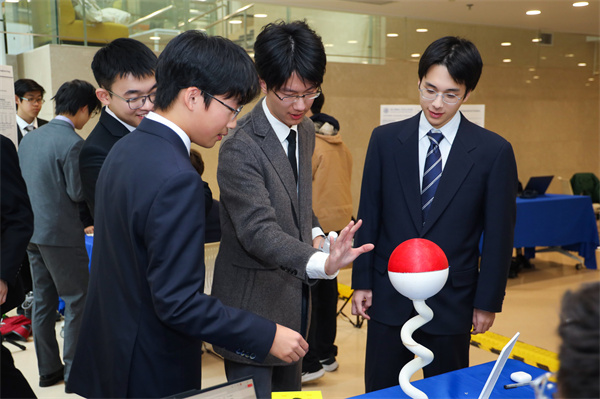
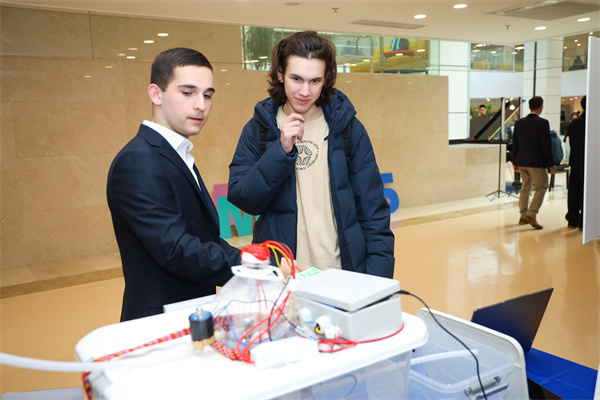
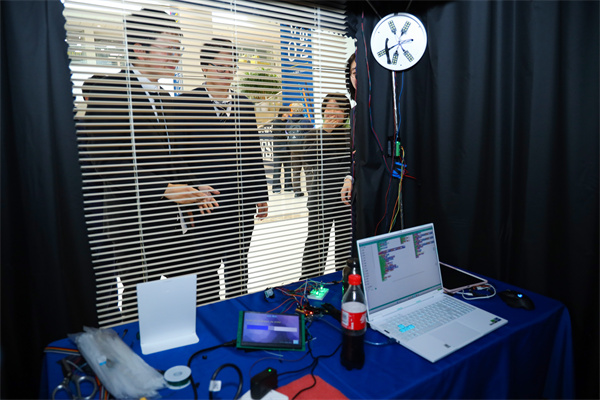
Projects by first-year students demonstrated how close observation of daily life can be transformed into practical engineering solutions through modular design and hands-on experimentation.

Among the showcased works was an Environmental Gas Monitoring Patrol Vehicle, designed to address limitations of traditional fixed air-quality monitoring systems. Capable of autonomous patrols, the vehicle integrates multiple gas sensors and a Wi-Fi-enabled camera to enable mobile, continuous, and automated monitoring, issuing alerts when safety thresholds are exceeded.

An Automatic Table Tennis Ball Collector tackled inefficiencies during sports training. Equipped with an AI vision module, the system can accurately identify and collect table tennis balls, significantly reducing manual effort and interruptions during practice.

To enhance cycling safety, a Bicycle Riding Assistance System combined lighting control, turn signals, hazard detection, and video recording through front and rear units connected via Wi-Fi. Using ultrasonic sensors and camera-based recognition, the system provides real-time warnings to riders and improves traffic safety.

Addressing campus life needs, a Washing Machine Queue Management System used camera recognition and a web platform to link users, laundry loads, and machines. The system enables real-time queue management and automated notifications, improving efficiency and user experience in shared laundry facilities.

Focusing on outdoor safety, a Dual-Energy Safety Jacket integrated solar panels and triboelectric sensors to achieve self-powered operation without external charging. The design allows rapid emergency alerts and improved wearer visibility, offering a practical solution for diverse outdoor scenarios.

The “Water and Light” Lighting and Filtration System addressed global challenges related to access to clean water and electricity. Powered by solar energy and constructed from easily accessible materials, the system provides daytime and nighttime lighting while incorporating ultraviolet-based water purification, targeting applications in remote and under-resourced regions.
Senior Projects: Engineering Solutions for Real Industrial Challenges
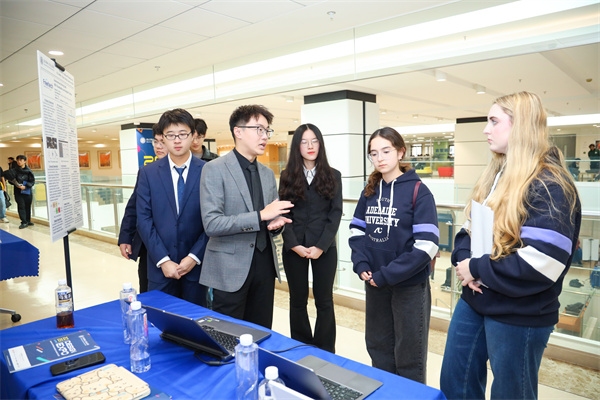

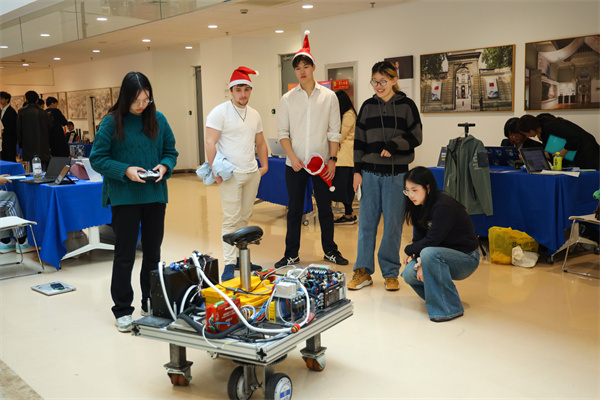
Senior-year projects focused on addressing real-world technical challenges faced by industry, demonstrating advanced engineering thinking, system integration, and technical depth.

The Virtual Drone View System designed the system for complex industrial environments such as mining and port operations. Using depth cameras, lightweight reconstruction pipelines, and GPU-accelerated rendering, the system generates real-time 3D views from point cloud data. Experimental results showed stable performance with low latency, offering strong potential for improving operational safety and efficiency.

A Programmable Aperture Photometric Stereo System was developed for precision industrial inspection of highly reflective surfaces. By integrating a programmable aperture into a dual telecentric optical system and applying dedicated reconstruction algorithms, the team achieved high-fidelity surface reconstruction in a compact setup, addressing limitations of traditional machine vision systems.

The AI-based Image Signal Processing (ISP) system focuses on image enhancement for automotive advanced driver-assistance systems (ADAS). It is designed for low-light conditions, adopted an end-to-end hybrid architecture capable of directly generating high-quality images. Performance evaluations demonstrated significant improvements over conventional ISP solutions, along with strong robustness and efficient deployment.
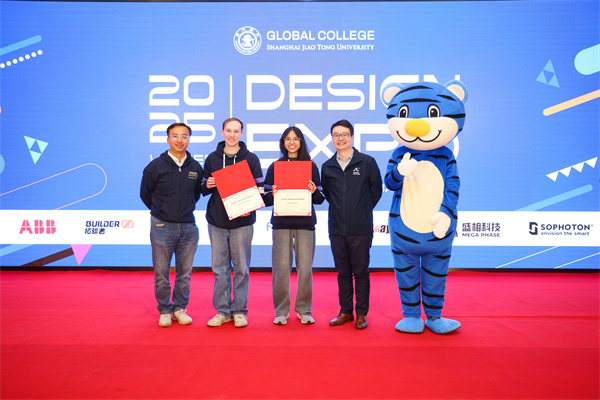
The winter design expo also welcomed an international delegation of 16 students from the University of Adelaide, Australia. Their two exhibited projects received strong recognition and were awarded the Global Trailblazer Award for international engagement.
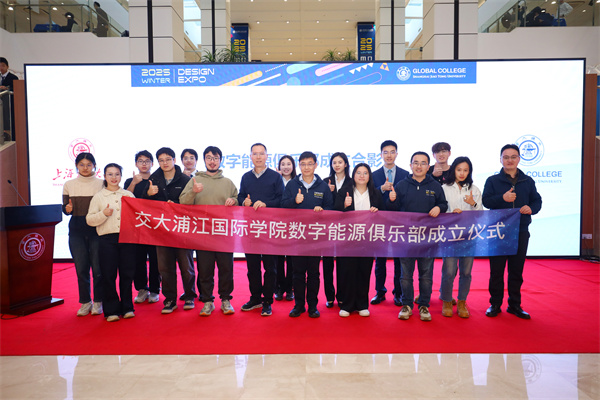
On the same day as the expo, the GC Digital Energy Club was officially launched. The club focuses on the digitalization, intelligence, and sustainable development of energy systems, adopting a training model that integrates multi-mentor guidance, project-driven learning, and collaboration across undergraduate, master’s, and doctoral levels. It brings together students interested in interdisciplinary fields such as mechanical engineering, automation and control, and electronic and information engineering. Centered on cutting-edge industry topics including novel high-altitude wind power structure design and implementation and multi-port, highly integrated energy routing and advanced applications, the club aims to strengthen students’ engineering capabilities and teamwork skills through sustained technical exploration and iterative project development.


College and enterprise representatives meet to discuss cooperation opportunities.
Industry–education integration remains a defining feature of GC’s graduation design program. Since 2010, the college has collaborated with more than 300 enterprises to jointly establish nearly 600 graduation design projects, forming a sustainable model that benefits both students and industry partners. By bringing real industrial challenges into the classroom, students experience the full lifecycle of engineering development, from problem definition and solution design to prototyping, testing, and final presentation.
Projects showcased at this year’s Winter Design Expo received sponsorship and support from multiple industry partners and alumni-founded enterprises, including ABB, Builder X, Mega Phase, Sophoton, CIML, Freetech, and Shanghai Greatway.
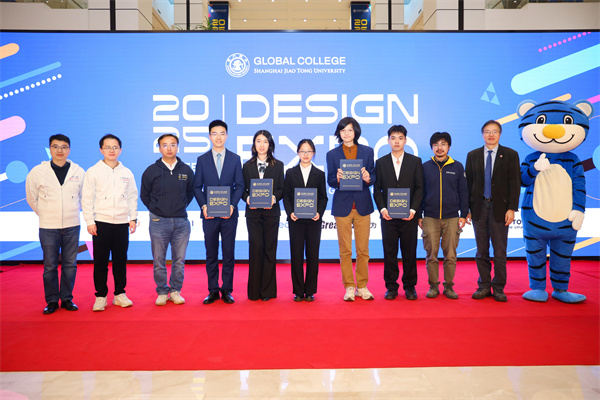
Group photo of gold award winning team


