


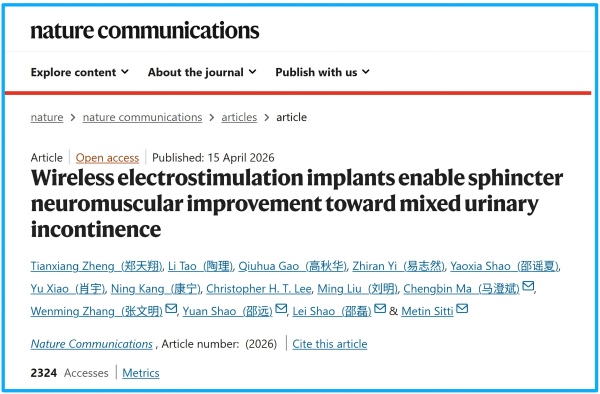
Two faculty members, Associate Professor Lei Shao and Professor Chengbin Ma, from Shanghai Jiao Tong University Global College (SJTUGC, abbreviated as GC hereafter), in collaboration with Director Yuan Shao from Ruijin Hospital, Wenming Zhang from SJTU School of Mechanical Engineering, and the research team of Metin Sitti at Koç University, have published a research paper titled “Wireless electrostimulation implants enable sphincter neuromuscular improvement toward mixed urinary incontinence” in the academic journal Nature Communications. GC doctoral student Tianxiang Zheng and Li Tao, a master’s graduate from Ruijin Hospital, are the paper’s co-first authors. Other collaborators include GC alumnus Ming Liu, a professor at SJTU School of Electrical Engineering, Yaoxia Shao, an assistant professor at Zhejiang University City College, Ning Kang, a postdoctoral researcher at Nanyang Technological University, and GC doctoral student Yu Xiao.
The study presents a tether-free and battery-free implantable flexible microsystem designed to deliver precise proximal electrical stimulation directly to the urethral sphincter while bypassing conventional long neural pathways. The technology aims to provide an integrated treatment solution for urge, stress, and mixed urinary incontinence, addressing limitations of existing clinical therapies that are often invasive, costly, and effective only for specific symptoms.
Mixed urinary incontinence, which combines symptoms of both urge and stress urinary incontinence, remains a major challenge in clinical urology. Existing sacral nerve stimulation therapies primarily target urge symptoms and typically require bulky implanted devices, while stress urinary incontinence treatments rely mainly on mechanical interventions and surgery that cannot restore neuromuscular function of the urethral sphincter.

WIPES microsystem and its working principle
To address these limitations, the research team developed the Wireless Implantable Platform for Electrostimulation of the Sphincter (WIPES), consisting of an external wearable transmitting coil and an internal flexible implantable device. The implant features an elliptical interlaced multilayer elastic encapsulation structure integrating wireless energy reception, wireless programmable pulse generation, and wireless control modules. Flexible C-shaped gold electrodes enable noninvasive attachment to the urethral sphincter and precise in-situ electrical stimulation.
By bypassing conduction loss in traditional long neural pathways, the system simultaneously regulates bladder neural signaling and promotes neuromuscular tissue repair in the sphincter. The microsystem measures less than 0.3 cm³ in volume and weighs below 0.9 g, achieving miniaturization, wireless operation, and long-term biosafety. In animal models, the incontinence relief rate reached as high as 97.92 percent. The researchers also identified mechanisms of improvement from the perspective of neuromuscular remodeling, providing experimental evidence for a potential minimally invasive treatment strategy for mixed urinary incontinence.
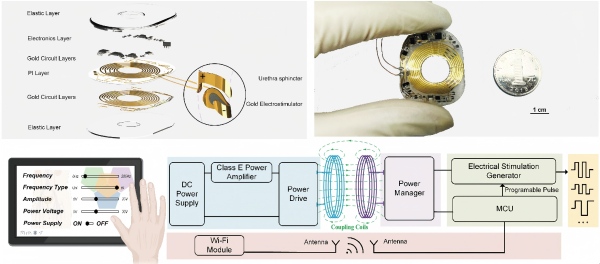
WIPES structural design and therapeutic approach
Author Introduction
Tianxiang Zheng
PhD Student
Tianxiang Zheng’s research focuses on wireless-powered miniature medical robotic systems, particularly in vivo microrobots and implantable electrostimulation systems. His work centers on wireless power transfer, miniature robotic system design, and biomedical applications. As first author, he has published papers in journals including Nature Communications and IEEE Robotics and Automation Letters, and has delivered oral presentations at international conferences such as IEEE APWCS and IEEE IROS. He has received honors including the Shanghai Outstanding Graduate Award and the SJTU Yu LiMing Scholarship.
Lei Shao
Associate Professor and Doctoral Advisor
Lei Shao’s research focuses on microelectromechanical systems (MEMS), ultra-precision measurement technologies and instruments, as well as microsensors and microrobots for interdisciplinary biomedical engineering applications. He has received support from programs including the Shanghai Sailing Program, the National Key Research and Development Program Young Scientist Project, and national-level young talent initiatives. His research findings have been published in journals including PRL, Nature Communications, and IEEE Transactions journals.

Chengbin Ma
Tenured Professor and Doctoral Advisor
Chengbin Ma’s research interests include power electronics, control and optimization, high-frequency wireless power transfer, and their advanced applications in data centers, renewable energy microgrids and energy storage, humanoid robots, and implantable medical devices. He is an IEEE Fellow and currently serves as vice chair of the Wireless Power Transfer Committee of the China Electrotechnical Society, as well as associate editor of IEEE Journal of Emerging and Selected Topics in Industrial Electronics and IEEE Transactions on Industrial Informatics (2016–2022). He has received honors including the 2019 Outstanding Research Award from the AirFuel Alliance in the United States, the First Prize of the 10th Science and Technology Progress Award (Basic Research Category) from the China Power Supply Society, and the 7th SJTU “Ko Guan Top Ten Teachers” Award.


