


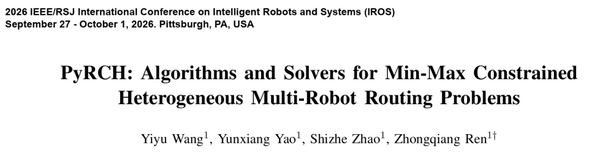
A research paper led by Yiyu Wang, an undergraduate student at Shanghai Jiao Tong University Global College (SJTUGC, abbreviated as GC hereafter), has been accepted by the 2026 IEEE/RSJ International Conference on Intelligent Robots and Systems (IROS 2026), a major international conference in robotics. The paper, titled “PyRCH: Algorithms and Solvers for Min-Max Constrained Heterogeneous Multi-Robot Routing Problems,” was co-authored by Wang, Associate Professor Zhongqiang Ren and other team members. Ren is the corresponding author.
The research was conducted at GC’s Robotics Autonomy and Planning Lab (RAP Lab), and the team has publicly released PyRCH, a solver designed for multi-robot task allocation and routing that balances solution quality with computational efficiency and provides bounded suboptimality guarantees.
In applications such as autonomous exploration and warehouse logistics, multiple robots must work together to visit a set of target locations. How tasks are assigned and visit sequences are planned directly affects the efficiency of the entire team. In heterogeneous teams consisting of aerial and ground robots, different robots have access to different areas. Real-world tasks may also be subject to battery capacity and specified service time windows. Planning must therefore determine which robot performs each task and in what order, while satisfying allocation, resource and time-window constraints.
When the objective is to complete the overall task as quickly as possible, a key measure is the completion time of the last robot, known as the makespan. Many existing public solvers focus on minimizing the total cost across all robots, leaving limitations in their applicability and performance when optimizing the maximum cost for heterogeneous teams under multiple constraints.
To address this problem, the research team developed an anytime focal search algorithm for multi-robot routing under various constraints. The algorithm can find a feasible solution first and then continue improving it as more computation time becomes available, while providing a bounded suboptimality guarantee. The team incorporated dominance-based pruning, constraint-feasibility checks and a minimum spanning tree heuristic that accounts for time windows to reduce redundant searches and eliminate branches that cannot yield feasible solutions.
After obtaining a complete solution, the algorithm further improves routes through 2-opt optimization, task reassignment among robots and route merging. These techniques help balance workloads and reduce unnecessary waiting. The team also implemented the algorithm as a modular C++ solver and provided a lightweight Python interface. Its optimization objectives, constraint checks and post-processing functions are organized as replaceable modules, making the solver easier for researchers to use and extend.

Representative routing results under allocation and resource constraints. The figure compares routes generated by PyRCH and baseline solvers for aerial and ground robots. The values in the boxes indicate the maximum route cost, while the charts below show each robot’s resource utilization. PyRCH produces more balanced routes and resource use while satisfying the constraints and reducing the team’s maximum completion time.
The team evaluated the solver on three maps with different terrain characteristics, using test instances with 60 to 150 target nodes and 5 to 20 robots. Each configuration was tested 30 times. Under a uniform time limit of 60 seconds, PyRCH was compared with existing open-source solvers PyVRP and Google OR-Tools, as well as an OR-Tools configuration optimized for load balancing.
The results showed that PyRCH consistently achieved lower makespan values in experiments involving allocation constraints alone and those involving both allocation and resource constraints. When time-window constraints were added, its solution quality was comparable to PyVRP and better than that of the tuned OR-Tools configuration. In representative tests with allocation and resource constraints, PyRCH found high-quality solutions in less than 0.1 seconds and continued to improve them as computation time increased, indicating its potential for online task planning.

Maximum route cost over computation time for different solvers: (a) allocation constraints only; (b) allocation and resource constraints. Solid lines represent average results across multiple experiments, and shaded areas indicate variation. PyRCH finds high-quality solutions quickly and further reduces the maximum route cost through continued search.
Wang noted that the research combines theoretically grounded search algorithms with a practical software tool to address real-world constraints in heterogeneous multi-robot coordination. The approach offers planning support for applications such as autonomous exploration and warehouse logistics. Future work will extend the solver to support additional constraints and optimization objectives, and develop search-priority strategies tailored to different tasks to improve efficiency by exploiting problem structure.

Yiyu Wang presents the research poster at IROS 2026.
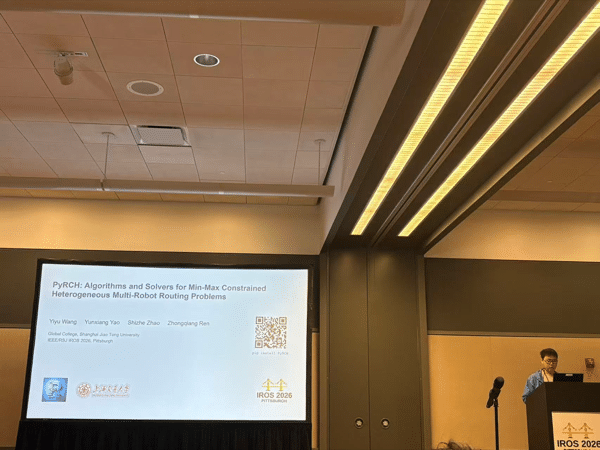
Yiyu Wang delivers an oral presentation at IROS 2026.
IROS 2026 is an internationally recognized conference in robotics, providing a broad platform for the exchange of research in robotics and intelligent systems. It was held in Pittsburgh, United States, from September 27 to October 1, 2026.
About the Authors

Yiyu Wang is an undergraduate student enrolled in 2023, majoring in Mechanical Engineering at GC. He is currently pursuing a bachelor’s degree in Computer Science in the United States through a dual-degree program. Under the supervision of Associate Professor Zhongqiang Ren, he has conducted research on task allocation and routing for heterogeneous multi-robot systems, contributing to core algorithm design, C++ implementation and experimental validation. He also released the solver as a Python package. Wang previously participated in a summer research program at Carnegie Mellon University.

Zhongqiang Ren is an associate professor and doctoral supervisor at GC. He received his PhD from Carnegie Mellon University and was selected for a national-level young talent program for overseas scholars. His research focuses on robot motion planning, autonomous navigation and multi-robot systems. He has published more than 40 papers in leading robotics journals and conference proceedings, including Science Robotics, IEEE Transactions on Robotics (TRO), Robotics: Science and Systems (RSS), ICRA and IROS. His work has received multiple best paper award nominations. He also serves in editorial roles for robotics journals and conferences, including TRO.


