


A research team led by Associate Professor Yulian He at Shanghai Jiao Tong University Global College (SJTUGC, abbreviated as GC hereafter) has published a research paper in Angewandte Chemie International Edition, titled “Breaking the Activity-Stability Trade-Off in Dry Reforming of Methane via Heteroenergetic Support Engineering”.

Methane (CH₄) and carbon dioxide (CO₂) are two major greenhouse gases. Dry reforming of methane provides a pathway to simultaneously convert these gases into syngas, a mixture of carbon monoxide and hydrogen, which can be further used for fuel and chemical production.
Nickel-based catalysts are considered promising for dry reforming of methane due to their relatively low cost and strong methane activation capability. However, the reaction typically requires high temperatures, under which nickel nanoparticles tend to sinter and accumulate carbon deposits, leading to catalyst deactivation. Improving catalyst stability while maintaining high activity remains a key challenge in this field.
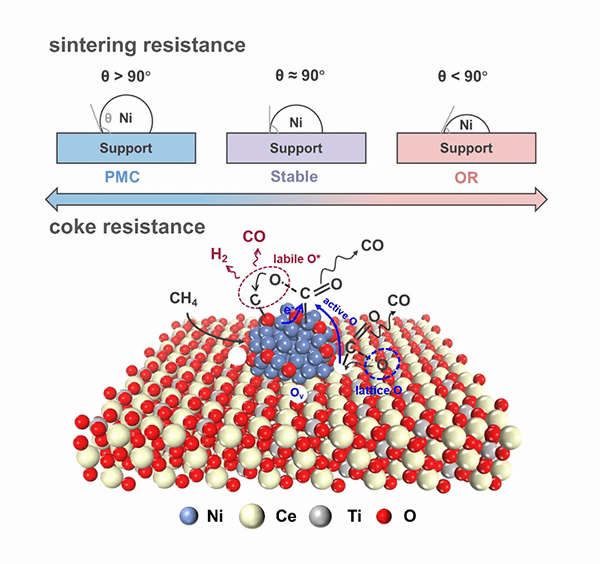
Schematic illustration of the mechanism by which heteroenergetic supports enhance resistance to sintering and carbon deposition
To address this challenge, the research team investigated the interaction between metals and catalyst supports. Using Neural Network Molecular Dynamics (NN-MD) simulations, the team analyzed nickel nanoparticles on different support materials and screened supports with different Ce/Ti ratios based on the contact angle between nickel particles and the supports.
The calculations showed that different supports exert different effects on nickel nanoparticles. Among the candidates, the Ce₀.₇₅Ti₀.₂₅O₂₋ₓ support produced nickel particles with a contact angle close to the intermediate wetting state of approximately 90 degrees. Based on these results, the team prepared the selected support and verified the simulation results through experimental characterization, including electron microscopy analysis.
The team further evaluated the catalyst’s performance in dry reforming of methane. The results showed that support engineering improved the structural stability of nickel particles under high-temperature conditions. Meanwhile, the optimized support enhanced the formation and migration of active oxygen species, helping suppress nickel sintering and remove carbon species generated during the reaction. These improvements enabled a better balance between catalytic activity, anti-sintering performance, and resistance to carbon deposition.
The study demonstrates that quantitative analysis of metal-support interactions through computational methods, combined with experimental validation, can provide new approaches for catalyst design in high-temperature catalytic systems. By integrating Neural Network Molecular Dynamics simulations with experimental research, the work offers a strategy for rational catalyst design and efficient material screening.
GC master’s student Mengyao Bao and Si Rui Zhan, a Ph.D. student at the SJTU School of Chemistry and Chemical Engineering, are co-first authors of the paper. SJTU professors Yulian He and Xueqing Gong are co-corresponding authors.
Personal Introduction

Mengyao Bao is a master’s student of 2024 cohort majoring in Mechanical Engineering with a focus on Materials at Shanghai Jiao Tong University Global College. Her research focuses on catalyst design for dry reforming of methane and AI-assisted studies of catalyst structure–performance relationships. She has published four SCI papers in international journals, including Angewandte Chemie International Edition and ACS Catalysis.

Yulian He is a dual-appointed Associate Professor at Shanghai Jiao Tong University Global College and the School of Chemistry and Chemical Engineering, and the head of the Catalysis and AI Laboratory. Her research focuses on interdisciplinary closed-loop heterogeneous catalysis integrating experiments, theory, and artificial intelligence. She received her bachelor’s degree from the School of Chemistry at Nankai University in 2016 and her Ph.D. from Yale University in 2020. She subsequently conducted postdoctoral research at Stanford University in the United States. She has been selected for the Shanghai Sailing Program and the Shanghai Leading Talent Program (Overseas). She has published more than 40 papers in leading scientific journals, including four papers in Journal of the American Chemical Society, one in Angewandte Chemie International Edition, two in Proceedings of the National Academy of Sciences, and one in Nature Communications. She has also contributed to four book chapters and serves on the editorial boards of several journals. She has led research projects funded by the National Natural Science Foundation of China, the Ministry of Education, and industry partners.


