


Shanghai Jiao Tong University Global College (SJTUGC, abbreviated as GC hereafter) has partnered with Trip.com Group, a leading global travel service provider, to organize an intercultural learning program that brought more than 20 international faculty members and students to Luoyang, Henan Province, for a five-day field study of traditional Chinese culture.
During the program, participants visited historical and cultural landmarks, including the Luoyang Museum, White Horse Temple, Longmen Grottoes, Yingtian Gate, and Mingtang and Tiantang. Through these visits, they explored the history of Luoyang, an ancient capital of 13 dynasties, and gained a deeper understanding of Chinese civilization and its cultural diversity.
Exploring an ancient capital through artifacts and archaeological sites
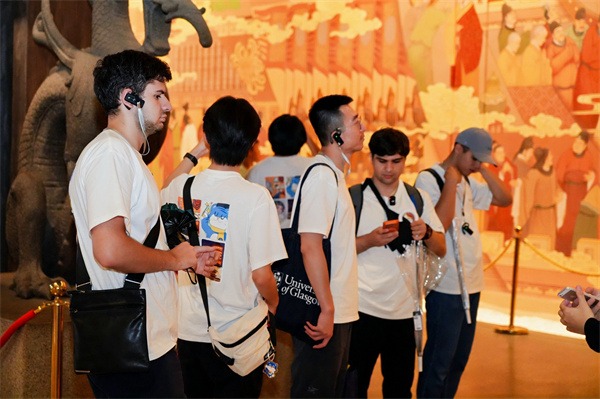

Luoyang’s long history is reflected in both museum collections and the remains of ancient city sites. At the Luoyang Museum, participants traced the city’s historical development through a wide range of artifacts, from simple pottery and bronze vessels to colorful Tang sancai, or three-color glazed pottery. These objects offered insights into the city’s cultural heritage spanning thousands of years.
At the Sui and Tang Luoyang City ruins, the imposing Yingtian Gate and the reconstructed Mingtang and Tiantang complex helped participants visualize the scale and layout of the imperial capital during the Sui and Tang dynasties, as well as the ceremonial traditions that shaped its urban design. By examining museum collections alongside the city ruins, they developed a clearer understanding of Luoyang’s historical role as an ancient capital and a hub along the Silk Road.
Discovering cultural exchange through Buddhist temples and grottoes


White Horse Temple and the Longmen Grottoes offer vivid examples of how different cultural traditions have spread, interacted, and converged in Luoyang. At White Horse Temple, participants explored traditional Chinese Buddhist temple architecture alongside palace and garden complexes featuring Indian, Thai, and Myanmar styles. Comparing architectural forms and decorative patterns helped them understand how Buddhism became integrated into Chinese culture and experience the dialogue between civilizations across geographical boundaries.
At the Longmen Grottoes, participants walked along the West Hill Grottoes and visited notable sites, including Binyang Cave, Lotus Flower Cave, and Fengxian Temple. The imposing Vairocana Buddha, subtle variations in the drapery and facial features of the sculptures, and inscriptions preserved on the cliff faces illustrated the evolution of artistic styles from the Northern Wei to the Tang dynasty. These works also revealed the rich artistic traditions that emerged through the long-term integration of Buddhism and Chinese art.
Experiencing traditional craftsmanship and dress


Hands-on activities allowed participants to move beyond observing Chinese cultural heritage to experiencing it firsthand. At the Tang Sancai Town, participants visited a pottery workshop to learn about the production process, including wheel throwing, glazing, and firing. With guidance from intangible cultural heritage practitioners, they selected unglazed ceramic pieces and applied glaze themselves, gaining practical insight into the distinctive colors and techniques of Tang Sancai pottery.
At the Peony Museum, participants dressed in Hanfu, traditional Chinese clothing, and styled their hair and makeup before exploring the exhibitions and taking photographs. The interplay of traditional attire, floral displays, and the historic surroundings offered opportunities to appreciate the beauty of traditional Chinese dress while creating personal memories of Luoyang.

The field study encouraged international students to step beyond the classroom and experience Chinese history and civilization firsthand. Through immersive activities, they gained a more authentic, multidimensional, and comprehensive understanding of China, moving from learners of Chinese culture toward firsthand witnesses and storytellers of their experiences. The insights and reflections they gained in Luoyang will continue to travel with them as they share their stories with others, allowing cultural dialogue to resonate in new encounters, much like the camel bells that once echoed along the ancient Silk Road.
The Luoyang field study was part of the “SJTU × Trip.com” intercultural learning program, an initiative supporting SJTU’s Global SJTU strategy and the development of its international education system. Through university-industry collaboration, the program integrates international students’ social practice with the exploration of Chinese culture, helping build a systematic, immersive, and open approach to experiential education for international students in China.


