


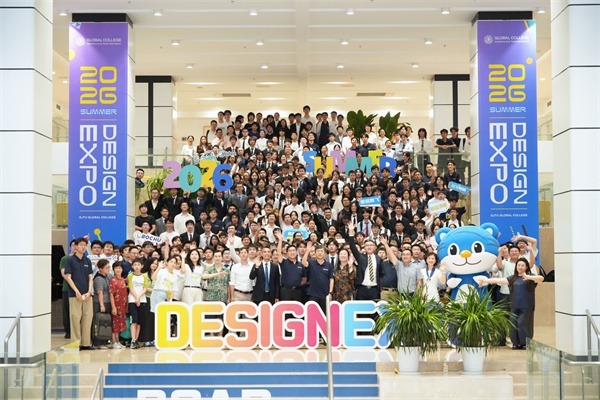
The 2026 Summer Design Expo of Shanghai Jiao Tong University Global College (SJTUGC, abbreviated as GC) was successfully held on August 5, showcasing more than 140 student projects spanning cutting-edge technologies, practical applications, and creative interactive designs. From a wind-powered forest fire detection system and an intelligent baby-monitoring cradle to robotic manipulation and industrial inspection solutions, the exhibition brought together faculty and students, industry representatives, and experts for discussion and exchange.
The projects were developed through experimental and design-oriented courses across all four undergraduate years, including Introduction to Engineering, System Design, and Computer Vision. Together, they presented a comprehensive overview of students’ creativity, teamwork, engineering thinking, and hands-on capabilities at different stages of their undergraduate education.
Freshman Projects: From Everyday Observation to Engineering Practice


Freshman projects demonstrated how observations of everyday life can be transformed into practical engineering solutions through creative thinking, teamwork, and hands-on experimentation.
Wind-Powered Forest Fire Detection System

Forest fires in remote mountainous areas can begin as smoldering fires and remain undetected for several days before developing into open flames. Conventional solar-powered monitoring equipment may have difficulty generating sufficient power under dense forest canopies, while battery replacement in remote areas can be costly and labor-intensive.
To address these challenges, students developed a wind-powered forest fire detection system designed for remote forest environments. A miniature wind turbine converts natural wind energy into electricity and stores it in a battery, enabling the system to continuously monitor temperature and humidity without relying on sunlight. When measurements exceed preset warning thresholds, the system transmits an alert with precise location information to a monitoring platform through long-range wireless communication. Multiple devices can also be connected into a network, reducing the need for manual patrols.
Biomimetic Butterfly Scout for Mars Exploration

Rugged terrain, steep craters, and narrow spaces can pose significant challenges for Mars rovers. A biomimetic flapping-wing aircraft developed by students was designed as a lightweight scouting platform to help rovers assess terrain ahead.
The aircraft uses a carbon-fiber frame and lightweight kite fabric for its wings. Independently driven flapping wings generate lift, allowing the aircraft to explore areas that are difficult for ground vehicles to access, such as narrow cracks and cliff edges. By transmitting high-definition images in real time, the system could help researchers identify potential terrain risks before a rover enters an unfamiliar area.
Viewfinder: Reimagining Space through a Camera Frame

The 2D puzzle-platform game Viewfinder combines platforming with creative spatial mechanisms. Players can use a camera frame as a tool to solve puzzles and manipulate the game environment.
The game allows players to fix a camera frame in place and use its edges to perform long jumps. Players can also collect scattered word fragments and combine them on a 3×3 grid to modify rules within the frame, enabling interactions such as passing through walls and walking against gravity. The project demonstrates how creative game design can be combined with engineering and interactive technologies to create new forms of gameplay.
Intelligent Baby-Monitoring Cradle

An intelligent baby-monitoring cradle developed by students aims to provide more active and timely assistance to parents. Instead of continuous video recording, the system captures an image every five seconds and uses AI to identify the baby’s condition. When the baby wakes up, the system can notify parents within three seconds and automatically activate gentle rocking to provide comfort.
The cradle is equipped with universal wheels for convenient movement and can remain on standby for up to 240 hours on a full charge. Historical status records can also be accessed in the background, allowing the system to integrate monitoring, notification, and automated response into a single solution.
Senior Projects: Engineering Solutions for Real-World Challenges


Senior projects focused on real-world technical challenges in industrial applications, public services, and specialized operations. Drawing on their accumulated engineering knowledge and practical experience, students applied integrated approaches to problem analysis, system design, implementation, and validation.
Autonomous Exploration and Mapping for Robotic Manipulation

Robots operating in unfamiliar and confined environments often rely on pre-built maps. Unknown layouts and obstacles can significantly limit their autonomous operation. Students developed a fully autonomous system for a six-degree-of-freedom robotic arm equipped with a depth camera. Without requiring prior environmental information, the system collects point-cloud data while moving and constructs a three-dimensional probabilistic map in real time. It automatically selects optimal observation viewpoints, plans exploration paths, and generates safe, collision-free trajectories.
The system was validated in both simulation and on a physical robotic platform. It enables autonomous target-search operations in unknown and constrained environments and shows potential for applications in industrial inspection and operations in specialized environments.
Wearable Safety Inspection System for Industrial Applications

Traditional industrial inspections often rely heavily on visual observation and workers’ experience, making some potential hazards difficult to identify in time. Students developed a wearable safety inspection system that integrates AR glasses with an industry-specific AI model. Using Rokid glasses, the system captures first-person video and transmits it to a backend system for analysis by a fine-tuned industry-specific model. In addition to identifying common safety violations, the system can detect potential risks and provide visual and voice alerts to workers in real time.
The system is designed for three high-risk scenarios: construction sites, oil and gas facilities, and laboratories. With a false-positive rate below 4.6%, it provides a potential solution for shifting industrial inspection from post-event checking toward real-time risk prevention.
Dexterous Robotic Hand for Object Manipulation

A low-cost dexterous hand system developed by students enables a robotic hand to rotate objects to specified angles based on joint sensing data, without relying on an external camera to continuously track the object. Using a pretrained policy and a rapid adaptation module, the system autonomously coordinates the movements of 16 joints while estimating the orientation of an object during manipulation. Once the target angle is reached, the robotic hand can stop accurately.
The project provides a deployment-oriented solution balancing control performance, robustness, and real-time operation, offering a technical basis for stable and low-latency goal-oriented manipulation in uncertain environments. Potential applications include industrial sorting and service robotics.
Integrated Control System for Humanoid Robots

Students also developed an integrated system for the Unitree G1 humanoid robot, enabling coordinated operation across vision, language, manipulation, and locomotion. The robot can understand natural-language commands and perform everyday tasks such as picking up objects, walking while carrying items, placing objects in drawers, and transferring objects between its hands. The system adopts a two-layer architecture consisting of a semantic layer and a control layer. A vision-language model translates natural-language instructions into action intentions, while a high-speed controller coordinates the movements of the arms, torso, and legs at nearly 50 Hz.
The team collected hierarchical demonstration data through VR teleoperation and completed full-process validation in simulation, laying a foundation for more general-purpose manipulation capabilities in humanoid robots.
Industry–Education Integration: Bringing Real-World Challenges into the Classroom

Industry–education integration remains a defining feature of the capstone design program at GC. Over the past decade, the College has worked with more than 240 leading companies to bring real industrial challenges into the classroom, creating a practice-oriented model that enables students to develop their ability to solve complex engineering problems.

Since the model was formally introduced in 2010, GC has collaborated with industry partners on nearly 500 customized capstone projects covering emerging fields including artificial intelligence, robotics, green energy, 6G communications, and integrated circuits. These projects have closely followed the development of emerging technologies and evolving industry needs.
To strengthen practice-based training, GC has integrated capstone projects across different majors into unified required courses and invited companies to participate throughout the project design process. A dual-mentor model, bringing together faculty members and industry experts, provides students with guidance throughout the development process. Leading companies including Intel, Midea, ABB, and Visteon, as well as alumni-founded enterprises such as Bach Electronics, Shengxiang Technology, and Daimon Robotics, have participated in this industry–education ecosystem. Some outstanding student projects have subsequently been applied in enterprise production and operations, creating a mutually beneficial cycle in which students strengthen their engineering capabilities, companies address technological challenges, and the college continuously advances its educational practice.
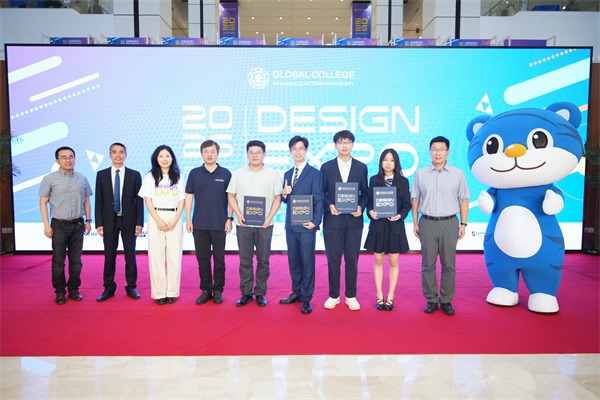
Group photo of the Gold Award-winning Capstone Design team


