


A research paper from the Advanced Diagnosis and Automatic Control Laboratory (ADAC Lab) at Shanghai Jiao Tong University Global College (SJTUGC, abbreviated as GC hereafter) received the Third Prize Award at the IEEE PES (China) Smart Grid & Emerging Technologies Satellite Committee Annual Meeting and the ACA Cyber-Physical Security and Control Technology Committee Annual Meeting held in Guiyang, Guizhou Province from May 16 to 18.
The awarded paper, titled “Enhancing Situation Awareness in Microgrids: A 3D Transmission Line Circuit Modeling Approach for Batteries,” was selected for a special presentation at the conference. GC Professor Mo-Yuen Chow is the corresponding author of the paper first-authored by master student Ziqi Wang. The conference was jointly organized by the IEEE PES (China) Smart Grid & Emerging Technologies Satellite Committee and the ACA Cyber-Physical Security and Control Technology Committee.
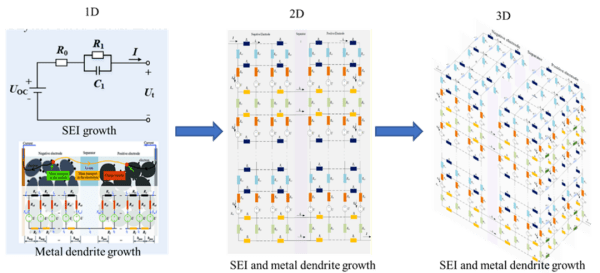
With the increasing deployment of microgrids and battery energy storage systems (BESSs), ensuring the safe and reliable operation of lithium-ion batteries has become increasingly critical. In practical microgrid operation, especially under contingency or disaster scenarios, effective energy management requires the knowledge of battery availability and awareness of internal degradation risks. However, existing battery monitoring approaches mainly rely on terminal measurements such as voltage, current, and temperature, which treat batteries as black boxes and fail to capture internal spatial heterogeneity
To address this challenge, the research team proposed a three-dimensional transmission line circuit framework for spatial-temporal battery modeling. By constructing a physics-based electrothermal network that captures localized electrochemical and thermal heterogeneity inside batteries, the proposed approach enables more accurate condition monitoring and situational awareness for resilient microgrid systems. The research provides a practical modeling framework that combines physical interpretability with real-time applicability, demonstrating strong potential for condition-aware battery management, reliability-oriented energy dispatch, and enhanced resilience in future smart grid applications.
Author Introduction

Ziqi Wang is a GC master’s student in Control Science and Engineering enrolled in 2024. She received her bachelor’s degree in Automation from Shandong University. Her research focuses on battery incipient fault detection and diagnosis, and digital twin technology, where physics-based circuit models serve as a core component. The technologies can balance model fidelity and real-time performance, thereby enhancing the safety and reliability of battery systems. She has published first-author papers in international conferences, including IEEE ICIT and IEEE ICIEA.

Mo-Yuen Chow received his B.S. degree in Electrical and Computer Engineering from the University of Wisconsin–Madison in 1982, and his M.Eng. and Ph.D. degrees from Cornell University in 1983 and 1987, respectively. He has been a GC professor since 2022 and is Emeritus Professor in the Department of Electrical and Computer Engineering at North Carolina State University.
Dr. Chow is the Director and Founder of the Advanced Diagnosis, Automation, and Control (ADAC) Laboratory and Advanced Interdisciplinary Energy Research Center (AIERC). His recent research focuses on Dynamic Energy Management Systems, AI-Enhanced Disaster Power Restoration, and Smart Battery Incipient Fault Detection, Diagnosis and Digital Twin. He is an IEEE Life Fellow, the Co-Editor-in-Chief of IEEE Trans. on Industrial Informatics 2014-2018, Editor-in-Chief of IEEE Transactions on Industrial Electronics 2010-2012. Dr. Chow has received the IEEE Region-3 Joseph M. Biedenbach Outstanding Engineering Educator Award, the IEEE ENCS Outstanding Engineering Educator Award, the IEEE ENCS Service Award, the IEEE Industrial Electronics Society Anthony J Hornfeck Service Award, and the IEEE Industrial Electronics Society Dr.-Ing. Eugene Mittelmann Achievement Award. He is a Distinguished Lecturer of IEEE Industrial Electronics Society since 2014. He has been consistently listed among top 0.05% highly ranked scholar-lifetime in the specialty of smart grid and Stanford University’s top 2% of scientists worldwide. Over the course of his career, he has led and contributed to more than 77 government (e.g. NSFC-RFIS-Ⅲ) and industry-funded research projects. He holds 10 U.S. patents and has authored 380+ papers in reputable IEEE Transactions and leading international IEEE conferences.


