


A research paper from the Advanced Diagnosis, Automation, and Control Laboratory (ADAC Lab) at Shanghai Jiao Tong University Global College (SJTUGC, abbreviated as GC hereafter) has received the IEEE Industrial Electronics Society (LES) Student & Young Professionals Assistance (SYPA) Award.
The award-winning paper, titled “Temperature-Dependent Modeling of the Solid Electrolyte Interface Growth via a Physics-Based Equivalent Circuit Framework”, was presented at the 27th IEEE International Conference on Industrial Technology (ICIT 2026), held in Monterrey, Mexico, from March 4 to 6, 2026. The paper was first authored by GC master’s student Ziqi Wang, with Professor Mo-Yuen Chow serving as the corresponding author.
The IEEE IES SYPA Award aims to support students and young professionals in presenting their research at leading international conferences and expanding their international academic networks. Due to the limited number of recipients and the highly competitive selection process, the award is regarded as a highly prestigious recognition.
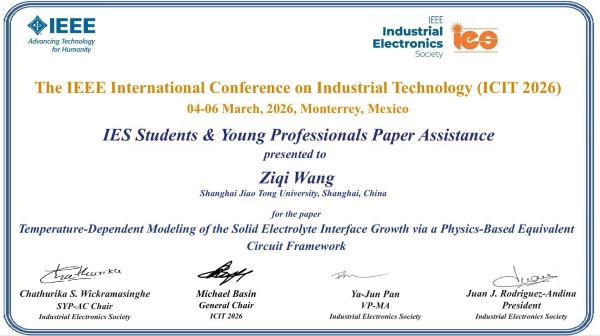
Certificate of IEEE IES SYPA Award
With the global transition toward low-carbon and electrified energy systems, the safety and lifespan of lithium-ion batteries have become increasingly critical. During long-term operation, batteries inevitably undergo performance degradation. Among various mechanisms, the solid electrolyte interface (SEI) growth is widely recognized as one of the root causes of battery faults. Meanwhile, batteries typically operate under complex and dynamic conditions, where temperature significantly affects the SEI formation and evolution. However, it remains a major challenge to accurately characterize the temperature-dependent SEI growth while satisfying the real-time requirements of battery management systems.
To address this issue, the award-winning paper proposes a physics-based equivalent circuit modeling framework that explicitly incorporates temperature-dependent SEI growth kinetics into the circuit model, achieving a balance between computational efficiency and physical interpretability. The proposed approach embeds SEI growth into the dynamic evolution of circuit model parameters. By integrating physical mapping relationships with two-stage parameter identification strategy, the model can effectively capture SEI growth behaviors under varying temperature. The study provides a modeling paradigm that combines physical insights with practical applicability, offering strong potential for advancing battery digital twin technologies and ensuring the safe and reliable operation of energy storage systems and electric vehicles.

Ziqi Wang is a GC master’s student in Control Science and Engineering enrolled in 2024. She received her bachelor’s degree in Automation from Shandong University. Her research focuses on battery incipient fault detection and diagnosis, and digital twin technology, where physics-based circuit models serve as a core component. The technologies can balance model fidelity and real-time performance, thereby enhancing the safety and reliability of battery systems. She has published first-author papers in international conferences, including IEEE ICIT and IEEE ICIEA.

Mo-Yuen Chow received his B.S. degree in Electrical and Computer Engineering from the University of Wisconsin–Madison in 1982, and his M.Eng. and Ph.D. degrees from Cornell University in 1983 and 1987, respectively. He has been a GC professor since 2022 and is Emeritus Professor in the Department of Electrical and Computer Engineering at North Carolina State University.
Dr. Chow is the Director and Founder of the Advanced Diagnosis, Automation, and Control (ADAC) Laboratory and Advanced Interdisciplinary Energy Research Center (AIERC). His recent research focuses on Dynamic Energy Management Systems, AI-Enhanced Disaster Power Restoration, and Smart Battery Incipient Fault Detection, Diagnosis and Digital Twin. He is an IEEE Life Fellow, the Co-Editor-in-Chief of IEEE Trans. on Industrial Informatics 2014-2018, Editor-in-Chief of IEEE Transactions on Industrial Electronics 2010-2012. Dr. Chow has received the IEEE Region-3 Joseph M. Biedenbach Outstanding Engineering Educator Award, the IEEE ENCS Outstanding Engineering Educator Award, the IEEE ENCS Service Award, the IEEE Industrial Electronics Society Anthony J Hornfeck Service Award, and the IEEE Industrial Electronics Society Dr.-Ing. Eugene Mittelmann Achievement Award. He is a Distinguished Lecturer of IEEE Industrial Electronics Society since 2014. He has been consistently listed among top 0.05% highly ranked scholar-lifetime in the specialty of smart grid and Stanford University’s top 2% of scientists worldwide. Over the course of his career, he has led and contributed to more than 77 government (e.g. NSFC-RFIS-Ⅲ) and industry-funded research projects. He holds 10 U.S. patents and has authored 380+ papers in reputable IEEE Transactions and leading international IEEE conferences.


